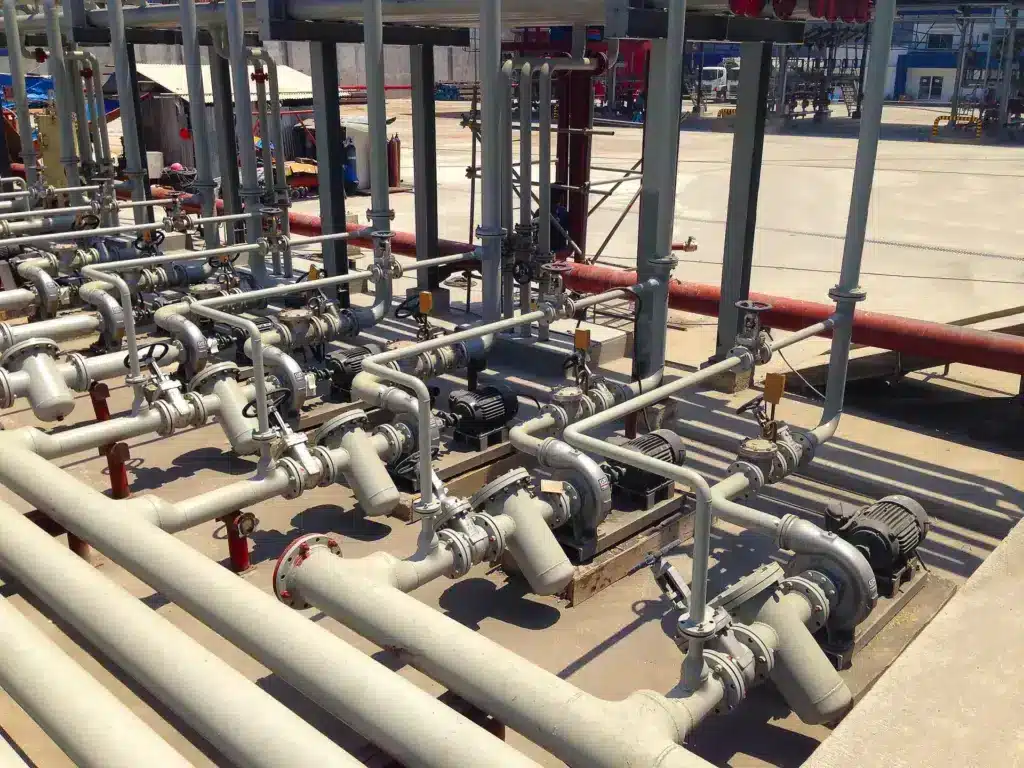


The oil & gas value chain requires pumps that keep running with changing fluids, fluctuating suction conditions, and high requirements for safety and uptime. This article provides a practical selection guide: which pump fits exploration, processing, bulk storage, and transfer, and what to check before selecting a series or configuration.
Quick selection guide
- Exploration and drilling sites
Choose (wet- or dry-installed) self-priming pumps if you handle oil, drilling mud, and wastewater and need fast start-up without complicated priming procedures - Bulk storage and transfer
Consider Roto Prime or 0-series pumps for clean, non-abrasive petroleum products when you want to load/unload safely and strip hoses - Viscous media and dosing
Gear pumps are a logical choice when you need a constant, pulse-free flow and accurate dosing for oil, lubricants, or chemicals - General process water flows
Standard centrifugal pumps are often the cost-efficient baseline choice for general applications, depending on material selection and sizing - Rapid deployment
Consider a pump set if you want a complete unit that can be installed quickly, mobile or stationary
What we mean by pumps for oil & gas
Pumps for oil & gas are used across multiple phases of the value chain, from exploration and production to processing, storage, and delivery. They often need to cope with air entrainment, contamination, fluctuating flows, and sometimes viscous liquids. That is why you typically see multiple pump types operating side by side in this sector, each with its own role.
Where pumps are used in the value chain
Exploration and production
At drilling sites, self-priming solutions are used to pump oil, drilling mud, and wastewater. Self-priming is practical here because you do not need to refill manually every time the suction line drains.
Processing and utilities
During processing, pumps are used for fluid transfer across different process steps. The best pump depends mainly on your liquid, your required flow, and the degree of contamination or air in the line.
Bulk storage, loading and unloading
In bulk storage and when unloading railcars, Roto Prime pumps are cited as a solution for transferring oil and fuels. They are designed for clean, non-abrasive petroleum products and automatically discharge air and vapour. This is useful for loading, unloading, and stripping hoses.
The main pump types for oil & gas
1) Self-priming pumps
Self-priming pumps are designed to pump liquids that may contain air, solids, and debris. They keep working even when the suction line is empty. A further advantage often highlighted is above-ground installation, because maintenance is easier and you spend less time working in confined spaces. Common fit
- Wastewater and process water with air entrainment
- Situations with fluctuating suction conditions
- Locations where maintenance must be fast and accessible
2) Dry self-priming pumps
Dry self-priming pumps automatically remove air from the suction line, enabling immediate start-up without manual priming. They are positioned as suitable for heavy-duty applications where reliability and rapid deployment matter, focusing on high flows, solids handling capability, and suction performance. Practical fit
- Temporary setups and rapid interventions
- Contaminated water and slurries, depending on the configuration
- Scenarios where you do not want to lose time during start-up
Note: This category also includes Roto Prime RD and RS series designed for petroleum products, chemicals, and solvents, with automatic priming for efficient handling of fuels and chemical liquids.
3) Standard centrifugal pumps
Centrifugal pumps use rotating impellers to create a continuous liquid flow. They are often presented as a cost-efficient solution due to their simple design and limited number of moving parts. Material selection and execution determine whether they fit your medium. Practical fit
- General pumping applications with relatively stable fluid properties
- Process flows where simplicity and maintainability matter
4) Gear pumps
Gear pumps deliver a constant, pulse-free flow and are suitable for controlled liquid displacement. They are explicitly mentioned as a good fit for thick, viscous liquids such as oils, lubricants, paints, and chemicals. Because they operate on the positive-displacement principle, they are suitable for accurate dosing. Practical fit
- Viscous media
- Dosing and mixing
- When a continuous, predictable flow is required
5) Pump sets
If you need fast deployment and do not want to build everything yourself (engine, frame, connections), pump sets are a logical route. They are positioned as fully assembled solutions in mobile or stationary configurations: electric, diesel, or battery-powered. Practical fit
- Temporary projects, maintenance shutdowns, or turnarounds
- Remote sites where you need to be operational quickly
- Capacity buffer for peak demand
Selection criteria: how to avoid a misfit
Use this checklist before locking in a series or type.
Fluid and contamination
- Is the liquid clean and non-abrasive? Then a solution like Roto Prime or 0-series fits many transfer duties
- Does it contain air, debris, or solids? Then you are often better served by (dry) self-priming variants explicitly designed for that
Viscosity and dosing
- Do you need to move viscous liquids or dose accurately? Then a gear pump is often the most direct match
Suction conditions and start-up
- Can the suction line run empty, or do you have air entrainment? Self-priming prevents operational standstill due to start-up issues
Maintenance and accessibility
- Does the pump need to be installed above ground for safer and faster maintenance? Self-priming setups are often used above ground for exactly that reason
Common mistakes with pumps in oil & gas
- Selecting based only on flow and pressure, while your medium, contamination, and suction conditions often determine real reliability
- Forgetting that transfer and hose stripping require air and vapour handling. This is exactly why Roto Prime is cited in that context
- Trying to run a viscous liquid on a pump not intended for constant displacement and dosing. Consider gear technology instead
- No plan for maintenance access. Above-ground installation can make a real difference for safety and downtime
Practical checklist: what you want defined upfront
- Which fluid are you pumping, and is it clean, contaminated, abrasive, or viscous
- Are there solids present, and if so, how large and how often
- Is there air entrainment, or can the suction line drain
- Required flow and required head
- Fixed installation or must it be mobile
- Maintenance approach and required access speed
- Biggest risks: clogging, leakage, downtime, safety
- Do you also need to include loading/unloading or hose stripping in scope
Conclusion and next step
Pumps for oil & gas are not a one-size-fits-all category. In practice, you combine pump types per process step: self-priming for sites with air and contamination, Roto Prime for clean petroleum products in transfer duties, gear pumps for viscous media and dosing, and pump sets when you need rapid deployment. If you want to map this to your situation, make a short list of your fluids, suction conditions, and your flow/head range. That lets you make a targeted selection and avoid a misfit.
FAQ about pumps for oil & gas
For transferring oil and fuels, Roto Prime pumps are mentioned, among other reasons because of automatic discharge of air and vapour, and suitability for loading, unloading, and hose stripping.
Dry self-priming pumps automatically remove air from the suction line, allowing them to start immediately without manual priming.
Dry self-priming pumps automatically remove air from the suction line, allowing them to start immediately without manual priming.
For general applications with continuous flow where a simple design and maintainability are important, a centrifugal pump is often a cost-efficient choice.
If you want to be operational quickly with a complete, assembled solution, mobile or stationary, a pump set often fits better than building it yourself.