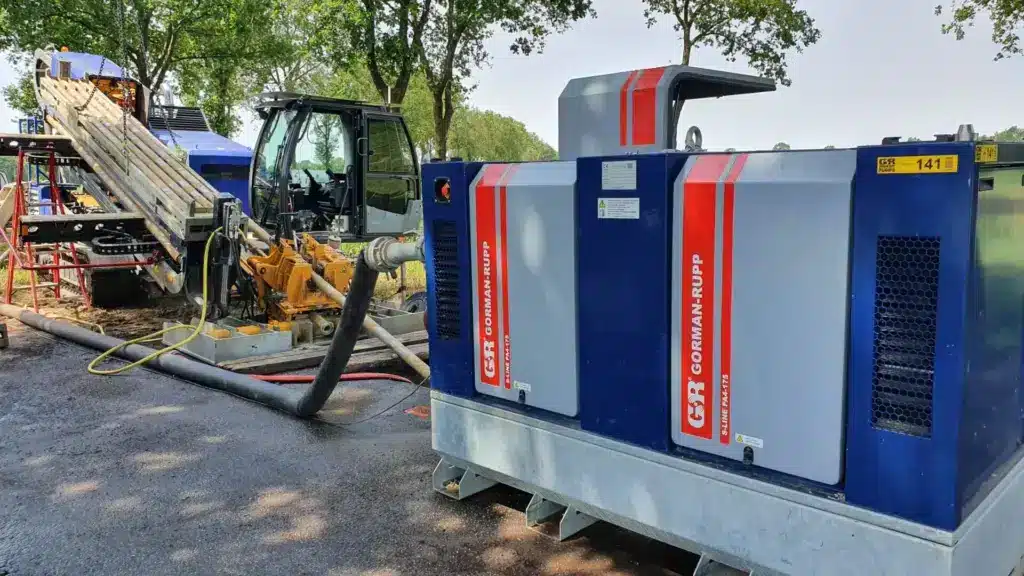



Noise is no longer a secondary specification. In urban projects, near hospitals, in residential areas at night, and in protected zones, sound levels are a primary constraint that determines whether a project can run at all. A mobile pump set that is loud during the day may be unworkable at night. This page explains the noise sources on a mobile pump set, the available attenuation options and the configurations Gorman-Rupp offers for noise-sensitive projects.
Where the noise comes from
Three main sources contribute to mobile pump set sound levels: the engine or motor, the pump itself and the airflow through the cooling and exhaust paths. Diesel engines typically dominate; the combustion process, mechanical noise from valvetrain and turbocharger, and exhaust pulses combine to give untreated diesel sets sound levels of 75 to 90 dB(A) at 7 metres. Electric motors are inherently much quieter; the dominant source on an electric set becomes the pump itself plus cooling fans. Pump noise depends on duty point, suction conditions and cavitation; running outside the allowable operating range can substantially raise sound levels.
Sound attenuation options
Sound-attenuated enclosures use multi-layer construction with absorbing and damping materials, designed airflow paths and acoustic baffling on intake and exhaust. A well-designed enclosure can reduce a diesel set’s sound level by 10 to 20 dB(A) without compromising cooling. Active monitoring and VFD speed control on the E-Line further reduce noise during part-load operation; running at lower speed produces lower sound output.
Operating in regulated zones
Many European cities apply night-time limits of 50 to 55 dB(A) at residential boundaries; some specific zones go lower. Standard diesel mobile pump sets without sound attenuation will exceed these limits. The path forward depends on the project: sound-attenuated diesel for autonomy with reduced noise, electric (E-Line) for the lowest noise profile and zero on-site emissions, or hybrid setups where electric is used near the boundary and diesel further inside the site.
Choice between sound-attenuated diesel and electric
A sound-attenuated S-Line is the right choice when grid power is unavailable, fuel logistics are already in place and night work is required. The E-Line is the right choice when grid power is reliable, the project benefits from VFD speed control and zero on-site emissions are desired or required. In many city projects today, the E-Line is the simpler and more compliant option.
Gorman-Rupp configurations for quiet operation
Sound-attenuated S-Line trailer-mounted versions for road-mobile diesel duty in noise-restricted zones. E-Line on Super T or Super U platforms for whisper-quiet electric duty. Custom enclosures and acoustic packages on request for projects with specific decibel targets at boundary lines.
Frequently asked questions
E-Line sound levels are typically 10% lower than a comparable diesel unit. A 10% reduction in decibels (dB) represents a significant reduction in sound pressure. As the decibel scale is logarithmic, a 10% decrease results in a reduction in sound intensity by a factor of 10.
Sound intensity/energy: The sound becomes 10 times less intense (only 10% of the original sound power remains).
Sound pressure (Pascal): The actual sound pressure is reduced to approximately 31.6% of the original value.
Perceived loudness: To the human ear, a reduction of 10 dB sounds like a halving of the sound volume.
Yes, the enclosure is designed for continuous operation with proper airflow.
Yes, running at lower speed reduces both motor and pump noise.