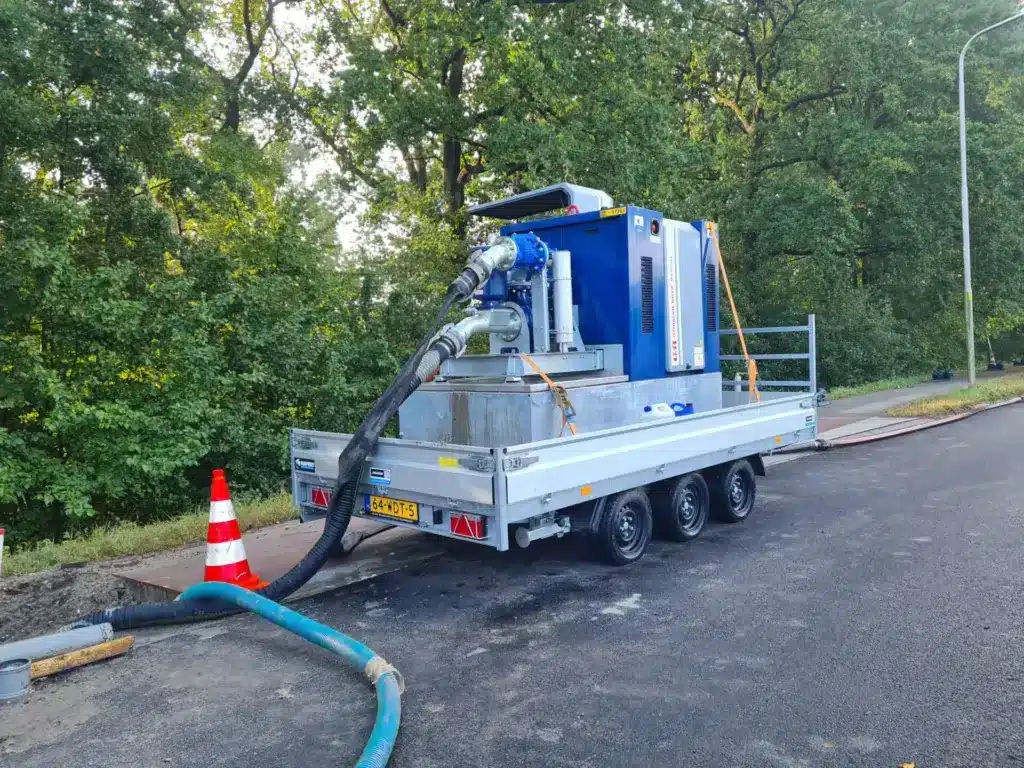

When it comes to pump rental, it’s rarely just “rent a pump and you’re done”. On site, you deal with variable inflow, solids, elevation differences, hose friction losses, noise or emission requirements and often time pressure too. If the duty point and the installation don’t match, you end up with unnecessary breakdowns, extra supervision, and delays.
That’s why we created ArchyRental.com: a platform that lets you select, reserve, rent, and manage pumps for your project.
When do you choose pump rental?
Pump rental is often the most practical option for:
- Temporary dewatering on construction sites and civil projects
- Emergency and maintenance situations such as wastewater or sewer bypass pumping
- Temporary process or utility jobs in industry and government
- Test or pilot setups before final specification
With a rental setup you can move fast, adjust capacity, and configure the installation on a project basis.
Which pump types do you typically see in pump rental?
Within Archy you’ll find mobile pump sets such as:
- Self-priming centrifugal pumps
- Diaphragm pumps
- Electric or engine-driven options
You can also filter the range by product group (such as centrifugal pumps, submersible pumps, booster pumps, diaphragm pumps, and vacuum pumps).
The 6 data points you need upfront (this determines whether it’s right “first time”)
Pump rental can solve a lot—but it’s not something you want to guess. This input makes the difference:
1) Flow and head (duty point)
- Required flow in m³/h
- Required head in metres of water column (mWC)
- Consider friction losses from hose length, bends, and couplings
In the Archy pump selector, you enter flow and head directly to find suitable options.
2) Fluid
Think about:
- Clean water
- Wastewater or sewage
- Abrasive liquid
- Bentonite
3) Solids and solids handling (free passage)
- Type of solids (sand, stones, silt, fibres)
- Maximum size
The selector lets you steer on maximum free passage (input range up to 150 mm).
4) Suction conditions and (self-)priming
A centrifugal pump does not actively “suck”; it creates a pressure drop at the suction side, so atmospheric pressure pushes the fluid into the pump. In practice this means:
- Keep suction hose length limited and prevent air ingress
- Choose the right priming approach (wet self-priming, dry self-priming, non-self-priming)
5) Drive type and on-site constraints
- Diesel, electric, or petrol selection options
- Noise requirement (sound-attenuated or extra-quiet electric)
6) Logistics: pick-up or delivery
Depending on planning and site access, you can choose to collect the unit or have it delivered.
How pump rental works via Archy (in practice)
Archy is designed to keep the process short and manageable:
- Select via filters or the pump selector
- Reserve online or by phone
- Rent and manage your pump(s) within the same platform
You can use our locations in Waardenburg (NL) and Suarlée/Namur (BE).
Common mistakes in pump rental (and how to avoid them)
- Underestimating the duty point by ignoring hose friction losses
- Solids larger than expected leading to the wrong pump selection
- Air ingress on the suction side due to couplings or excessive suction hose length
- Cavitation (imploding vapour bubbles) due to poor suction conditions or excessive resistance
Quick checklist for your request
If you share the items below, we can advise efficiently—or verify your selection in Archy:
- Flow (m³/h) and head (mWC)
- Fluid and temperature
- Solids + required free passage
- Installation: suction lift, pipe/hose lengths, dry/wet setup
- Drive type and noise preference
- Pick-up or delivery