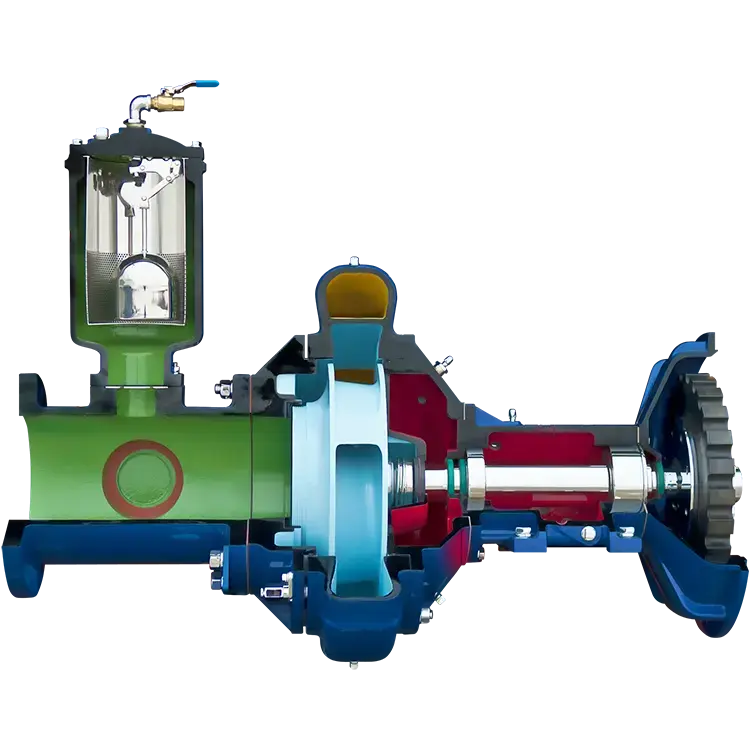
Cavitation is one of the most common and damaging phenomena in centrifugal pumps. It leads to reduced performance, increased wear and, in severe cases, complete pump failure. In this article, we explain exactly what cavitation is, how to recognise it and what measures you can take to prevent it.
What is cavitation?
Cavitation is the phenomenon whereby vapour bubbles form in a liquid because the local pressure drops below the vapour pressure of that liquid. At that moment, vapour bubbles form in the liquid. In a pump, this usually occurs during suction or at the impeller blades. When these bubbles subsequently enter an area of higher pressure, they collapse with enormous force (implode), which can cause serious damage. These implosions cause microscopic shock waves that damage the surface of the impeller and pump casing.
Please note: cavitation involves vapour bubbles, not air bubbles. The distinction is important: entrained air causes different problems, but cavitation is specifically the result of localised evaporation due to excessively low pressure.
Where does cavitation occur in a centrifugal pump?
Cavitation can occur on both the suction and discharge sides of the pump.
Suction side
Suction cavitation is the most common type of cavitation and is caused by the inlet pressure, the temperature of the fluid (vapour pressure), the suction conditions (inlet or suction), the pump speed, and the cavitation point forms on the suction side of the pump.
Specifically: the pressure on the suction side is lower than the vapour pressure of the liquid.
Where does suction cavitation occur:
- At the inlet of the impeller. The liquid is accelerated as it passes the blades, causing the local pressure to drop further. If the pressure here falls below the vapour pressure, vapour bubbles form.
- At sharp transitions. Surface irregularities, sharp edges or poorly adjusted wear rings can cause localised pressure drops.
- In the suction pipe. High pipe resistance, pipe diameters that are too small or sharp bends on the suction side reduce the available pressure at the pump inlet.
Discharge side
Occurs on the discharge side (outlet) of the pump or at the tips of the impeller blades.
- Cause: occurs when the pump’s discharge pressure is extremely high, often because the pump is operating against a (nearly) closed valve or excessive resistance in the discharge pipe. The fluid cannot leave the pump and begins to circulate within the pump casing.
- Consequence: due to the high velocity of the circulating fluid in the small clearances (between the impeller and the pump casing), vacuum pockets form and implode. This often damages the casing and the tips of the impeller blades.
Symptoms: how do you recognise cavitation?
Cavitation has recognisable signs:
- Noise. A characteristic ‘crackling’ sound, similar to the sound of gravel passing through the pump. With mild cavitation, the sound is subtle; with severe cavitation, it is clearly audible.
- Vibrations. Increasing vibrations in the pump and the pipework system, particularly on the suction side.
- Performance decline. The flow rate and/or head drop inexplicably, even if the system has not otherwise been altered.
- Material damage. On inspection, characteristic ‘pitting’ is visible on the impeller surface and the inside of the pump casing. The surface looks as though it has been worked with a nail.
- Increased energy consumption. The pump consumes more energy for lower performance.
NPSH: the key to cavitation prevention
NPSH (Net Positive Suction Head) is the parameter that determines whether a system can operate without cavitation.
NPSHa (available) is the available absolute pressure (expressed in metres of liquid column) on the suction side of a pump, corrected for vapour pressure. It is a measure of the energy available to draw liquid into the pump and prevent cavitation.
Key points regarding NPSHa:
- System-dependent: the NPSHa is determined by the system (liquid level, pipe friction, atmospheric pressure).
- Cavitation prevention: to prevent cavitation, the NPSHa must always be higher than the pump’s NPSHr (NPSH Required), preferably with a safety margin of at least 0.5 to 2 metres.
NPSHr (required) is the minimum net positive suction head required for the pump to operate cavitation-free. This is a pump characteristic determined by the manufacturer and specified in the pump performance curve.
Formula: the general formula for calculating NPSHa is:
NPSHa = ha + hz – hj – hvp
- ha: atmospheric pressure (or pressure at the liquid surface)
- hz: static height difference (positive for flooded suction, negative for suction lift)
- hj: friction losses in the pipe
- hvp: vapour pressure of the liquid (temperature-dependent)
If the pressure in the system is too low (NPSHa < NPSHr), cavitation occurs, which can lead to pump damage, noise and reduced performance.
Practical measures to prevent cavitation
- Lower the installation or raise the liquid level. The simplest measure: ensure that the liquid level is sufficiently above the pump inlet.
- Shorten and increase the diameter of the suction pipe. A shorter length, a larger diameter and fewer bends reduce pressure loss on the suction side.
- Keep the fluid temperature under control. At higher temperatures, vapour pressure increases, causing cavitation to occur sooner.
- Operate the pump within its design range. Avoid prolonged operation at extremely low or high flow rates. A variable frequency drive can help control the operating point.
- Choose a pump with low NPSH requirements. Pumps specifically designed for low NPSHr values provide greater margin in challenging installations. The Gorman-Rupp VG Series utilises dynamic positioning vanes that optimally guide the fluid to the impeller, resulting in significantly lower NPSH requirements. The VGH Series offers similar benefits in applications with slightly contaminated fluids.
- Consider a dry self-priming pump. Where suction conditions are structurally unfavourable (high suction head, fluctuating liquid levels), a dry self-priming pump may be a better solution than modifying the installation. See our guide to choosing a self-priming pump.
The VG Series and VGH Series are specifically designed to meet low NPSH requirements thanks to dynamic positioning vanes at the pump inlet.
Are you unsure whether your installation provides sufficient NPSH? Share your application details and we’ll calculate it together. Please contact Gorman-Rupp Europe.