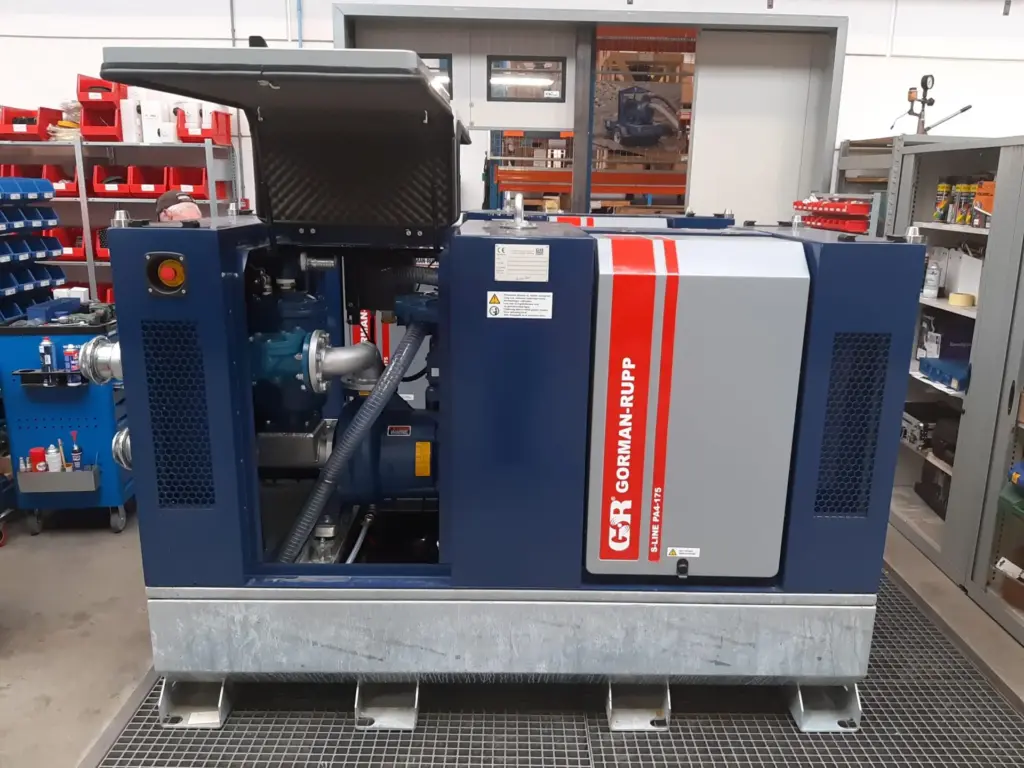



A diesel-driven mobile pump set is autonomous, transportable and built for sites without reliable grid power. An electric mobile pump set is quieter, has zero on-site emissions and offers precise speed control through an integrated variable frequency drive. Both deliver the same hydraulic performance when built on the same pump platform; the difference is in the operating context. This page compares both drive types on eight criteria so you can match the right configuration to the right project. For the full range, see our overview of mobile pump sets.
Short answer
Choose diesel when there is no grid connection, when continuous operation outside business hours is required, or when the site has heavy fuel logistics already in place. Choose electric when the project is in an urban area, a noise-sensitive zone, a zero-emission zone or when grid power is reliably available and project duration justifies the cable infrastructure.
How a diesel-driven mobile pump set works
A Stage V diesel engine drives the centrifugal pump through a flexible coupling arrangement. Stage V is the latest EU emissions standard for non-road mobile machinery and significantly reduces particulate matter and NOx compared with earlier stages. The set carries its own fuel tank, sized for typical run times of 24 to 72 hours depending on capacity. Diesel sets often run on HVO (Hydrotreated Vegetable Oil), a renewable drop-in fuel that lowers well-to-wheel CO2 emissions by up to 90 percent without engine modification. Read more about the S-Line diesel mobile pump sets or visit the S-Line product page.
How an electric mobile pump set works
An electric mobile pump set uses an electric motor coupled to the pump, with a variable frequency drive (VFD) that adjusts pump speed to the duty point. The VFD allows soft-start, energy-efficient part-load operation and the ability to match flow precisely to inflow at the application. The unit needs grid power or a generator. The Gorman-Rupp E-Line is built around the same self-priming pump technology as the diesel S-Line, so performance is comparable. Read more about the E-Line electric mobile pump sets or visit the E-Line product page.
Comparison on eight criteria
| Criterion | Diesel (S-Line) | Electric (E-Line) |
|---|---|---|
| Site autonomy | High, no grid needed | Requires grid, generator or battery power |
| Noise level | Higher; sound-attenuated options available | Whisper-quiet, suited to urban work |
| Local emissions | Stage V, low; HVO further reduces CO2 | Zero on-site CO2 emissions |
| Speed control | Electronic control panel | VFD with continuous speed control |
| Footprint and weight | Larger due to fuel tank | More compact for similar duty |
| Service profile | Engine service, fuel logistics | Motor service, electrical inspection |
| Investment | Generally lower upfront | Generally higher upfront |
| Operating cost | Fuel-driven, market-sensitive | Electricity-driven, more predictable |
Total cost of ownership
On TCO, the picture depends on hours of operation, fuel and electricity prices, and project duration. As a rule of thumb: high-utilisation duties on grid-connected sites typically favour electric on TCO; short, intermittent or off-grid duties favour diesel. Where regulation requires zero on-site emissions or strict noise limits, electric is often the only viable option regardless of TCO.
Sustainability: Stage V, HVO and zero-emission zones
Many European cities and infrastructure clients now require Stage V diesel as a minimum and increasingly demand zero on-site emissions in protected zones. HVO bridges the gap on diesel platforms, while electric mobile pump sets meet zero-emission requirements directly. Gorman-Rupp Europe’s “Where Blue Meets Green” approach and CO2 Performance Ladder certification underline our commitment in this area. More in our article on sustainable mobile pumping with HVO, electric drive and Stage V compliance.
Application matrix: which drive when
Construction dewatering on remote sites: diesel. Urban sewer bypass at night: electric. Long-duration dewatering with grid available: electric. Emergency flood response: diesel for autonomy, with electric backup if power is restored. HDD with bentonite slurry: diesel for site flexibility. Industrial process duty inside a facility: electric. Not sure which fits your project? Our application engineers are happy to advise.