

Sustainability in mobile pumping is no longer a marketing topic. Procurement specifications now include emissions criteria, fuel choice, electrification roadmaps and total carbon footprint calculations. Mobile pump sets that meet these criteria win projects; those that do not are eliminated in the prequalification stage. This page outlines the three main levers Gorman-Rupp Europe and our customers use to reduce the carbon footprint of mobile pumping operations.
Lever 1: Stage V diesel as a baseline
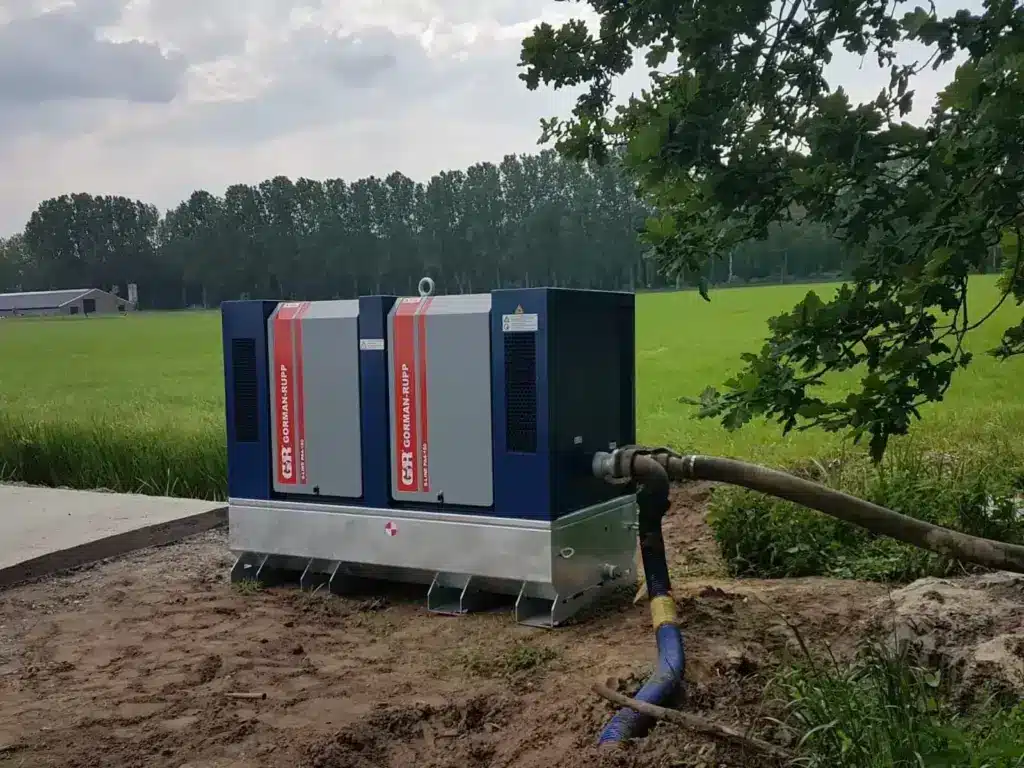
Stage V is the EU emissions standard for non-road mobile machinery and is now the regulatory baseline on most public infrastructure projects. Compared to earlier stages, Stage V engines reduce particulate matter and NOx significantly thanks to advanced after-treatment (DPF and SCR systems). The Gorman-Rupp S-Line is built around Stage V engines as standard, ensuring eligibility for projects that mandate this baseline.
Lever 2: HVO as a renewable diesel substitute
Hydrotreated Vegetable Oil (HVO) is a synthetic, paraffinic diesel produced from renewable feedstocks. It is a drop-in substitute for fossil diesel, requiring no engine modification, and reduces well-to-wheel CO2 emissions by up to 90 percent depending on feedstock. HVO is fully compatible with the S-Line Stage V engines. Customers can switch from fossil diesel to HVO without reconfiguring the equipment, achieving immediate lifecycle CO2 reduction.
Lever 3: Electric mobile pump sets
The E-Line eliminates on-site CO2 emissions entirely. Combined with electricity from renewable sources, lifecycle emissions reduce dramatically. Beyond the carbon argument, electric drives also support broader sustainability goals: lower noise, no diesel exhaust exposure for site workers, easier alignment with corporate net-zero commitments, and compliance with zero-emission zones in urban centres.
Where Blue Meets Green
Gorman-Rupp Europe’s “Where Blue Meets Green” approach is the framework that ties our product development and operations to sustainability goals. It covers the full value chain: product design (efficiency, durability, repairability), European assembly with reduced logistics emissions, the E-Line as our zero-emission flagship, HVO-compatibility across the diesel range, and end-of-life support including parts availability and refurbishment.
CO2 Performance Ladder
Gorman-Rupp Europe is certified on the CO2 Performance Ladder, the Dutch sustainability standard widely used in public procurement. Certification verifies that we measure our CO2 emissions, set reduction targets, implement measures and report transparently. For customers who require CO2 Performance Ladder evidence in tenders, our certification supports their submission.
How customers reduce footprint with Gorman-Rupp
A typical customer roadmap looks like this: replace ageing pre-Stage V equipment with Stage V S-Line for immediate compliance and lower local emissions; adopt HVO as the standard fuel where supply is available; introduce E-Line on projects with reliable grid power and night-time noise constraints; track total CO2 per project as part of customer reporting.
Beyond the engine: efficiency and durability
Sustainability is not only about the fuel. The Gorman-Rupp pump platforms (Super T, Super U, Ultra V) deliver high efficiency at the duty point, reducing energy demand. Service-friendly construction extends service life and reduces lifecycle environmental impact. Repair rather than replace is supported by widely stocked parts and the external shimless adjustment that restores performance without dismantling.
Frequently asked questions
HVO is increasingly available across Europe; supply varies by region. Check with your fuel supplier.
On-site, yes. Lifecycle emissions depend on the electricity source.
Yes, through the CO2 Performance Ladder and our “Where Blue Meets Green” reporting.