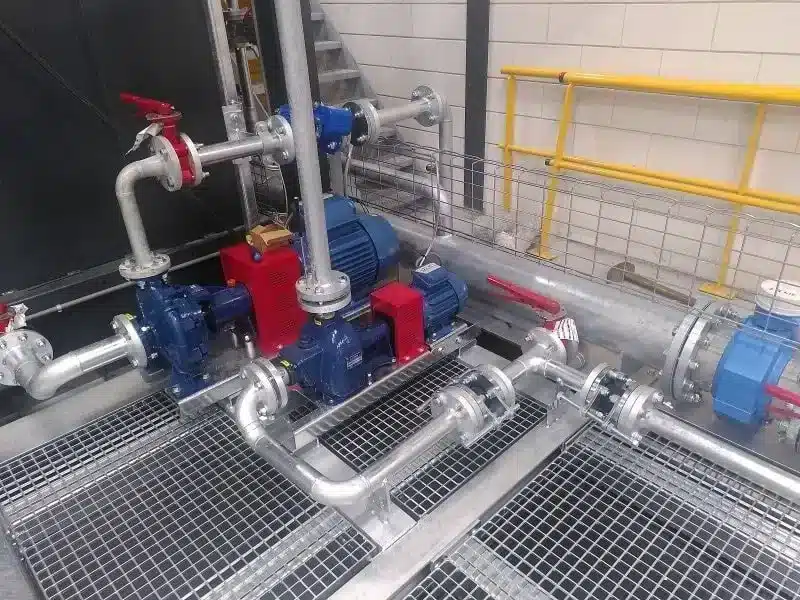


Selecting a centrifugal pump starts with the application, not a catalogue. Flow rate, head, the fluid to be pumped and the installation conditions together determine which pump type, materials and configuration are most suitable. In this article, we walk through the key selection criteria step by step.
The 5 selection steps at a glance
- Determine the required flow rate and head.
- Analyse the fluid (liquid, solids, temperature).
- Select the right impeller and casing type.
- Check the suction conditions (NPSH).
- Determine the installation configuration and drive.
Step 1: Establish flow rate and head
The duty point of a centrifugal pump is defined by two main parameters: the flow rate (Q, in m³/h) and the head (H, in metres of fluid column). The duty point must fall within the optimal operating range of the pump curve. A pump running consistently outside this range loses efficiency and wears faster.
Remember that pump performance is always given at the pump discharge port. So in your application, you need to consider pressure losses due to pipe friction and static heights as well.
Step 2: Analyse the fluid
Fluid type: clean water, process water, wastewater or a chemical medium? For clean fluids, a standard enclosed impeller suffices. For wastewater with solids, a solids-handling impeller is needed. For highly abrasive materials, a vortex style pump may even be advisable.
Solids: maximum particle size and concentration determine the minimum solids passage. The Gorman-Rupp 6400 Series even handles solids up to 102 mm.
Temperature: standard centrifugal pumps are designed for temperatures up to approximately 71 degrees C.
Corrosiveness: aggressive fluids require stainless steel or special alloys. Various Gorman-Rupp models are even available in Duplex stainless steel.
Step 3: Select impeller and casing type
Based on the fluid and duty point, select the impeller type:
- Clear fluids and lightly contaminated fluids at high pressure: enclosed impeller (0-series).
- Wastewater with large solids or fibrous media: two-vane solids impeller (T-V-6400 Series).
- Abrasive fluids: vortex impeller (6400 Series V-version).
- High pressures: multi-vane with dual volute (VS Series).
Step 4: Check suction conditions (NPSH)
NPSH (Net Positive Suction Head) is critical. If the available suction pressure is too low, cavitation occurs: vapour bubbles form that implode and damage the pump.
The rule: NPSHa must always exceed NPSHr, with a safety margin of at least 0.5 to 1 metre. Pumps with low NPSH requirements, such as the VG Series, reduce cavitation risk.
Step 5: Determine installation and drive
Mounting: Gorman-Rupp standard centrifugal pumps are horizontally dry-installed, simplifying maintenance.
Drive: electric motor or petrol / diesel engine, depending on power supply, location and operating hours.
Materials: standard ductile iron for most applications. Stainless steel, Duplex or ADI for aggressive or abrasive media.
Pump selection checklist
- Required flow rate (m³/h)
- Required head (m)
- Fluid type and composition
- Maximum particle size (mm)
- Fluid temperature
- Suction conditions (flooded or suction lift, NPSHa known?)
- Preferred mounting
- Drive type
- Special requirements (materials, certifications, ATEX)
Frequently asked questions
With the right application data you can make a preliminary selection. For a definitive choice, it is advisable to review system conditions with an application engineer.
Look beyond purchase price: consider energy consumption, maintenance requirements, parts, expected service life and downtime. A pump with slightly higher purchase cost but lower energy consumption and less maintenance is often more economical overall.
Want to know which centrifugal pump best fits your application? Share your application data (flow, head, medium, solids, installation type) and we will advise the right configuration. Contact Gorman-Rupp Europe.